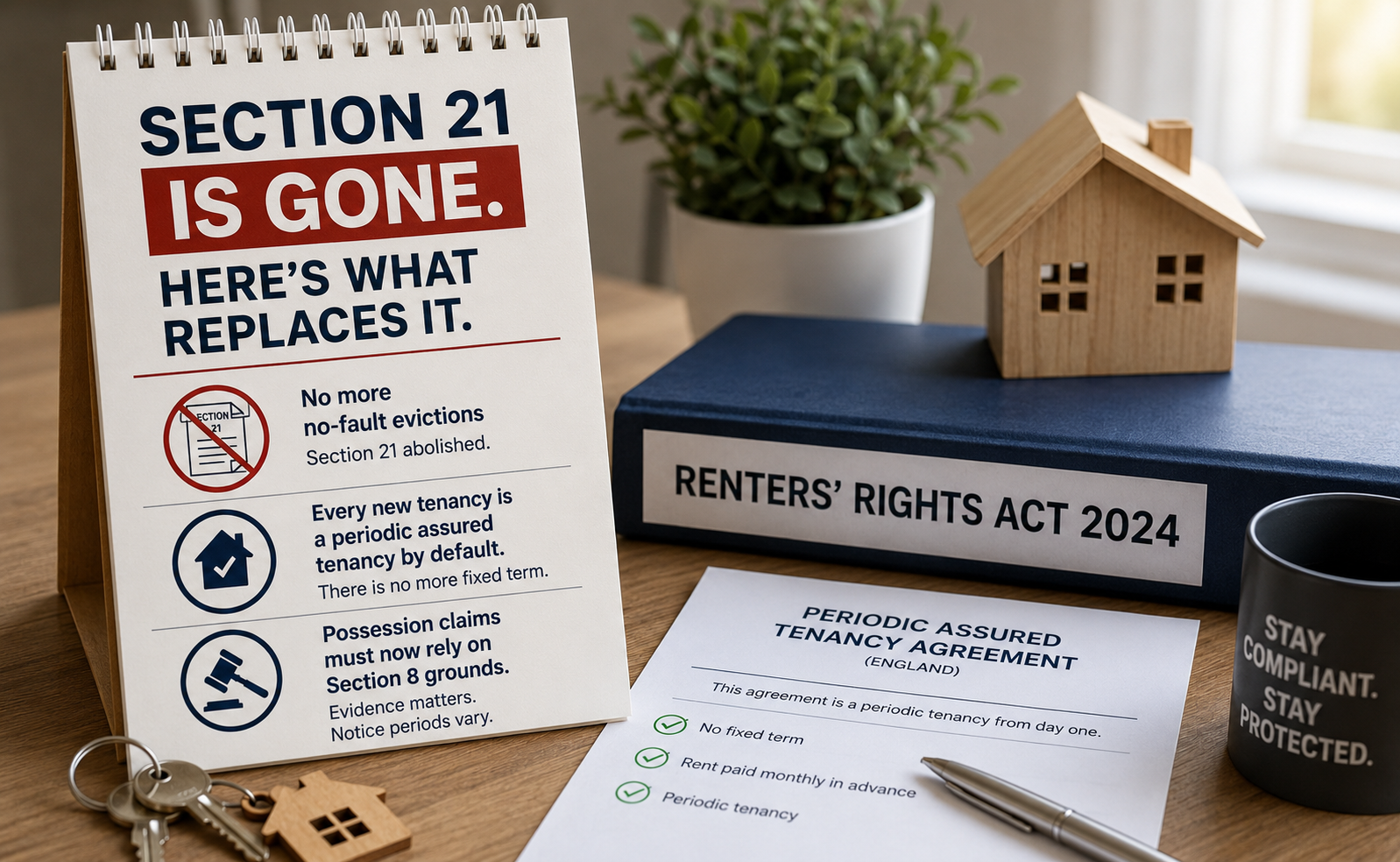
Section 21 is gone. Here's what replaces it.
The Renters' Rights Act abolished no-fault evictions in England. If you're still issuing fixed-term ASTs, stop.
The Renters’ Rights Act 2024 commenced in 2025 and has now abolished Section 21 “no-fault” evictions and assured shorthold tenancies (ASTs) across the private rented sector in England. Every new tenancy is a periodic assured tenancy by default. There is no more fixed term.
If you’re still signing fixed-term ASTs, the paperwork is void in respect of the fixed term, and any subsequent Section 8 possession claim relying on that fixed term will be struck out. This is the single biggest contractual change for private landlords in a generation.
What you have to do
- Update your AST templates. Remove any fixed-term clauses. Your template should describe a periodic tenancy from day one, with rent paid monthly in advance.
- Notify any agent you use. Letting agents are still circulating the old AST bundles. Confirm in writing with your agent that they’re using compliant templates before they sign a new tenancy on your behalf.
- Re-read Section 8. With Section 21 gone, every possession claim now has to rely on a statutory ground under Section 8 (rent arrears, anti-social behaviour, landlord moving back in, sale of the property, etc.). The grounds have been expanded to cover some of the use-cases Section 21 used to cover, but the evidence bar is higher and the notice period varies by ground.
What hasn’t changed
- The deposit rules (Tenancy Deposit Protection Schemes) are unchanged. Protect within 30 days, serve prescribed information within 30 days, or you cannot rely on a Section 8 claim and face a penalty of 1–3× the deposit.
- Right to rent, gas safety, EICR, EPC, smoke/CO alarms — all unchanged. These still apply regardless of tenancy type.
- Section 13 rent increases continue to work under the new regime, with the twelve-month minimum between increases preserved.
Where the risk actually lives
In practice, the biggest exposure for small landlords over the next 12 months is not the abolition itself — it’s the transition. Landlords who issued a fixed-term AST in late 2024 or early 2025, pre-commencement, often don’t realise the fixed term is now legally inoperative. If you try to rely on it in court, you’ll lose.
If you have tenancies from before the commencement date and you’re not sure of their status, the safest move is to re-paper them on a fresh periodic tenancy, with fresh deposit protection and a fresh prescribed information pack. It’s an afternoon’s work per property and eliminates the ambiguity.
Sources
- Renters’ Rights Act 2024 — legislation.gov.uk
- MHCLG guidance on the Renters’ Rights Act
- National Residential Landlords Association — tenancy reform
This is general information, not legal advice. If you’re unsure how the Act applies to a specific tenancy, get advice from a solicitor or your landlord association before acting.
Get briefings like this, monthly.
Landlord Brief is a short, plain-English digest of what's changing in UK rental law — with sources. One email on the 1st. Free.
Unsubscribe in one click from any email.