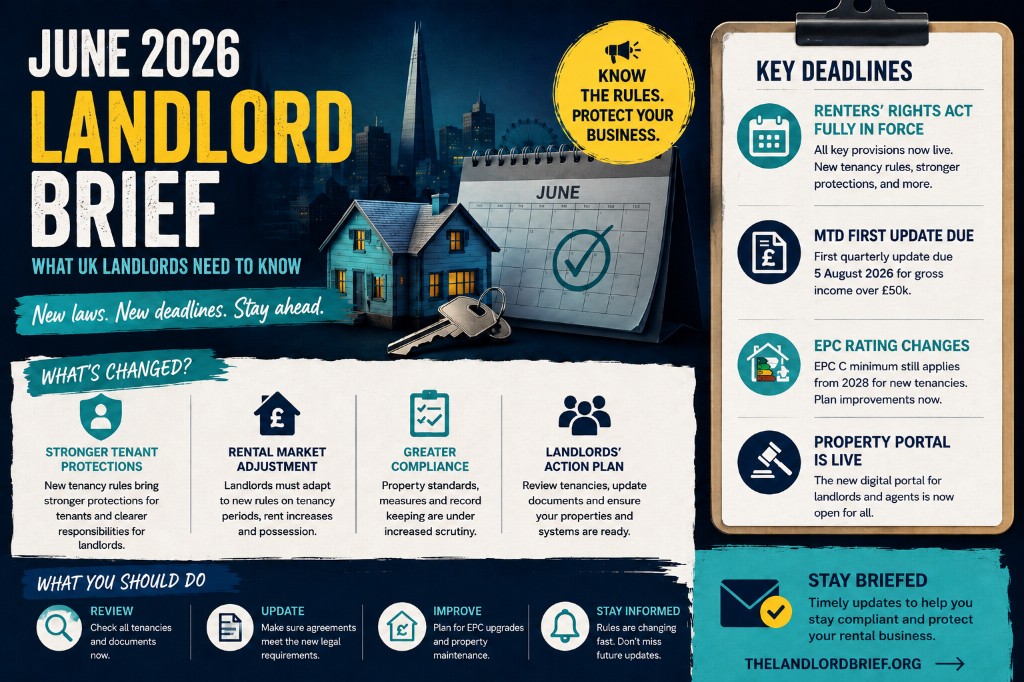
Section 21 deadline next month, MTD in progress — June 2026
Final cut-off for legacy evictions, plus two live Renters' Rights windows
This is the end of June 2026 edition of Landlord Brief, our monthly plain-English digest of UK private-rental compliance — what changed, what you have to do, and what you can safely ignore. Housing law is devolved, so each item below notes which UK nation it applies to.
This month’s risk level: High — Two hard deadlines this month – Section 21 court applications close 31 July, and student Ground 4A notices must be served by 30 July. Miss either and you lose the route permanently.
Critical actions this month
Last chance to apply for possession under old Section 21 notices
- Applies to: Landlords (England) who served a valid Section 21 notice before 1 May 2026
- Deadline: 31 July 2026
- What to do: If you served a Section 21 notice before 1 May 2026 and have not yet started court proceedings, you must apply to court by 31 July 2026. After this date, the notice expires automatically and you will need to use the new Section 8 grounds. Check the notice is still valid, gather supporting documents, and submit your claim form online or by post. Do not wait until the last week – courts are processing high volumes.
- Risk if ignored: After 31 July 2026, any unused Section 21 notice becomes void. You will have to start again using Section 8, with longer notice periods (typically 4 months instead of 2) and a requirement to prove a legal ground. No penalty for missing the deadline, but you lose a faster eviction route.
Serve student possession notices under transitional Ground 4A
- Applies to: Student HMO landlords (England) who notified tenants by 31 May 2026 of intention to use Ground 4A
- Deadline: 30 July 2026
- What to do: If you gave tenants written notice by 31 May that you may use Ground 4A, you can serve a notice of possession between 1 May and 30 July 2026 with just 2 months’ notice (instead of the standard 4 months). Use the correct form and ensure it reaches tenants before midnight 30 July. After this window closes, you revert to the standard 4-month notice period for student properties.
- Risk if ignored: Ground 4A is a transitional measure. If you miss the 30 July cut-off, you can still evict students using Ground 4A in future years, but you will need to give 4 months’ notice instead of 2 – meaning tenants may not vacate in time for the next academic year intake.
Check you gave the Renters’ Rights Information Sheet by 31 May
- Applies to: Landlords and agents (England) with tenancies agreed before 1 May 2026 that have a written agreement or written record of terms
- Deadline: Already passed (31 May 2026) – take remedial action now
- What to do: If you have not yet given every named tenant a copy of the official government Information Sheet (either printed or as a PDF attachment, not a link), do so immediately. Download the correct PDF from gov.uk/government/publications/the-renters-rights-act-information-sheet-2026 and send it by email or post. Keep proof of delivery. If your agent manages the property, they are responsible, but double-check it was done.
- Risk if ignored: Failure to provide the Information Sheet by 31 May 2026 is a criminal offence. Local authorities can fine you up to £7,000. The requirement still applies after the deadline has passed – compliance is mandatory, just late.
Submit your first Making Tax Digital quarterly update (if gross income over £50k)
- Applies to: Landlords and sole traders (UK) with gross property or self-employment income over £50,000 in 2024/25
- Deadline: Quarterly – first update due by 5 August 2026 (for period 6 April–5 July 2026)
- What to do: Use HMRC-compatible software to record all rental income and allowable expenses digitally. Submit your first quarterly update by 5 August 2026 covering 6 April to 5 July. This is not a tax return – it is a summary of income and expenses to date. Penalty points apply for late submissions (though HMRC is waiving points for the first 12 months from April 2026). If you have not signed up yet, do so at gov.uk/guidance/sign-up-for-making-tax-digital-for-income-tax.
- Risk if ignored: Late quarterly updates trigger penalty points. After four points, you face a £200 fine, then further fines for continued non-compliance. HMRC has said it will not issue penalty points for the 2026/27 tax year, but you must still submit updates – and you will still be fined for a late final tax return (due 31 January 2028 for the 2026/27 year).
New and changed rules
Renters’ Rights Act 2025 – Phase 1 in force from 1 May 2026
Status: In force (England only, private rented sector)
Section 21 no-fault evictions abolished. All assured shorthold tenancies converted to periodic assured tenancies on 1 May. Fixed-term tenancies no longer available. Landlords must now use Section 8 with a legal ground (e.g. rent arrears, anti-social behaviour, selling the property, moving in). Notice periods typically 4 months, though some grounds allow 2 months. Rent increases limited to once per year via Section 13 notice. Rental bidding banned. Tenants have right to request pets. Discrimination against tenants with children or on benefits prohibited. Local authority enforcement powers strengthened, including financial penalties up to £40,000 for serious or repeat offences.
Action: Review your processes now. If you plan to sell or move into a property within the next 12 months, familiarise yourself with Grounds 1 and 1A (landlord intends to sell or occupy). You cannot use these grounds in the first 12 months of a new tenancy. Update your tenancy agreements for any new lets from 1 May – you must provide written terms before the tenancy starts. Do not accept rent before the agreement is signed. Check your software or agent is compliant with the new rules on rent increases and advance payments.
Making Tax Digital for Income Tax – mandatory from 6 April 2026 (first wave)
Status: In force for those with gross income over £50,000
Sole traders and landlords with combined gross income from property and self-employment over £50,000 in 2024/25 must now keep digital records and submit quarterly updates to HMRC. Updates are due by the 5th of the month following each quarter end (5 Aug, 5 Nov, 5 Feb, 5 May). You still file an annual tax return by 31 January, but the software pre-fills it with quarterly data. The threshold drops to £30,000 from April 2027 and may extend to £20,000 from April 2028. Free and paid software options available. HMRC is waiving penalty points for late quarterly updates in the first year (2026/27) but fines still apply for late tax returns.
Action: If you have not signed up, do it now – you are already late for Q1. Choose MTD-compatible software, link it to your bank if possible, and start recording income and expenses digitally. If your income is close to the threshold, check carefully – it is gross income (before expenses) that counts, not profit. If you use an accountant or agent, confirm they are handling MTD on your behalf. Set calendar reminders for the 5th of August, November, February, and May.
EPC C deadline confirmed for October 2030 (all PRS properties)
Status: Regulations expected late 2026; compliance deadline 1 October 2030
Government confirmed in January 2026 that all privately rented properties in England and Wales must meet EPC C (or hold a valid exemption) by 1 October 2030. The original 2028 deadline for new tenancies has been scrapped – all properties now face a single 2030 deadline. Landlord cost cap reduced from £15,000 to £10,000 per property (lower for properties valued under £100,000). Costs incurred from 1 October 2025 count toward the cap. If you spend the cap without reaching C, you can register a high-cost exemption for 5 years. New-style EPCs using the Home Energy Model are due from October 2026 and will measure fabric performance, smart readiness, and heating system efficiency. Properties with EPC C under the current system achieved before October 2029 will be recognised as compliant for 10 years.
Action: Order an EPC for any property rated D or below (if the current certificate is near expiry) and review the recommendations. Prioritise improvements that give the biggest rating boost for the cost – typically loft and cavity wall insulation, and replacing old boilers. If your property already has solar panels or a heat pump, wait for the new EPC methodology (October 2026) as these may score higher. Keep receipts for all energy efficiency work from October 2025 onward – it counts toward your £10,000 cap. Do not leave this until 2029; installer availability will tighten as the deadline approaches.
Upcoming — next 90 days
- PRS Database registration (late 2026, phased by region) — From late 2026 (regional rollout). Government will launch a national database for private rented properties from late 2026, rolling out by region. All landlords will be required to register themselves and their properties, upload compliance documents (e.g. gas safety certificates, EPCs, electrical reports), and pay an annual fee (amount not yet confirmed). Registration will be mandatory before you can let a property. Start gathering your compliance certificates now and ensure they are up to date – the database will require evidence of legal compliance. Watch for announcements on which regions go live first.
- New-style EPCs using Home Energy Model (from October 2026) — October 2026 (planned). The current EPC system will be replaced in October 2026 with a new model that assesses fabric performance, smart readiness, and heating system efficiency separately. Properties with gas boilers may score worse; those with heat pumps or solar panels may improve. The new EPC will still have A–G bands but the route to C will change. If your property is borderline (e.g. high D), consider waiting until the new system launches before commissioning a new EPC – the rating may shift in your favour. Government will publish final guidance and banding thresholds closer to October.
Other stuff worth knowing
- What to do if you missed the 31 May Information Sheet deadline — If you have not given tenants the official Renters’ Rights Act Information Sheet by 31 May, you are technically in breach – but it is not too late to fix it. Download the correct PDF from gov.uk (search ‘Renters Rights Act Information Sheet 2026’), send it to every named tenant as an email attachment or printed copy, and keep proof you sent it. Do not send a link – the rules require the actual PDF file. Local authorities can fine you up to £7,000 for non-compliance, though enforcement action is more likely if a tenant complains. If you served a Section 21 or Section 8 notice before 1 May and the notice has since expired or the court case finished without possession, you have one month from that date to provide the sheet – check the specific timeline in the gov.uk guidance.
- Section 21 and Ground 4A: Know the difference — There is confusion between the Section 21 deadline (31 July) and the Ground 4A deadline (30 July). Section 21 is the old no-fault eviction route, abolished from 1 May 2026 but still usable if you served notice before that date – you have until 31 July to start court proceedings. Ground 4A is a new, time-limited ground for student HMO landlords, available only between 1 May and 30 July 2026, allowing 2 months’ notice instead of 4 for the 2025/26 academic year. If you are a student landlord, you needed to notify tenants by 31 May that you might use Ground 4A; you then have until 30 July to actually serve the possession notice. After 30 July, Ground 4A reverts to a 4-month notice period. These are separate rules for different situations – if in doubt, check the gov.uk guidance or speak to a solicitor before serving any notice.
Get the next brief in your inbox
Landlord Brief is the monthly UK landlord compliance digest. We cover the Renters’ Rights Act 2026 in England, Private Residential Tenancies in Scotland, Occupation Contracts in Wales, and the separate framework in Northern Ireland — plus UK-wide tax (MTD for Income Tax), EPC consultation outcomes, lender criteria changes, and Bank of England rate moves. Citations to gov.uk in every issue.
30-day free trial. Then £6.99/month. Card on file at signup; cancel any time.
Start your 30-day free trial →
Landlord Brief is general information, not legal advice. For decisions that affect a specific property or tenancy, talk to a solicitor or a member of the NRLA / Propertymark.
Get briefings like this, monthly.
Landlord Brief is a short, plain-English digest of what's changing in UK rental law — with sources. One email on the 1st. Free.
Unsubscribe in one click from any email.