The Decent Homes Standard now applies to private lets. What that means in practice.
The DHS has been extended from social housing into the PRS. Here's the minimum you'll be inspected against.
The Decent Homes Standard (DHS) has been extended from the social rented sector into the private rented sector in England. Local authorities now have the power to inspect private lets against the standard and issue civil penalty notices where a property fails.
This matters because the DHS is a minimum floor, not a quality benchmark. It’s the level below which a home is legally considered non-decent — which can trigger enforcement action, rent repayment orders, and in the worst cases a prohibition order that stops you from letting the property at all.
The four DHS criteria
A home is “decent” only if it meets all four:
- It meets the statutory minimum standard for housing. Specifically, it must be free of Category 1 hazards under the Housing Health and Safety Rating System (HHSRS). The most common failures are damp and mould, excess cold, fall risks, and fire safety.
- It is in a reasonable state of repair. Key building components (roof, walls, windows, chimneys, heating system, electrical system) must be neither seriously defective nor beyond their life expectancy in a way that makes the property uncomfortable.
- It has reasonably modern facilities. A kitchen and bathroom of a certain minimum age and specification, appropriate insulation, and common parts that are reasonably maintained.
- It provides a reasonable degree of thermal comfort. Effective insulation plus an efficient heating system. In practice this overlaps significantly with the EPC regime.
What a DHS inspection actually looks at
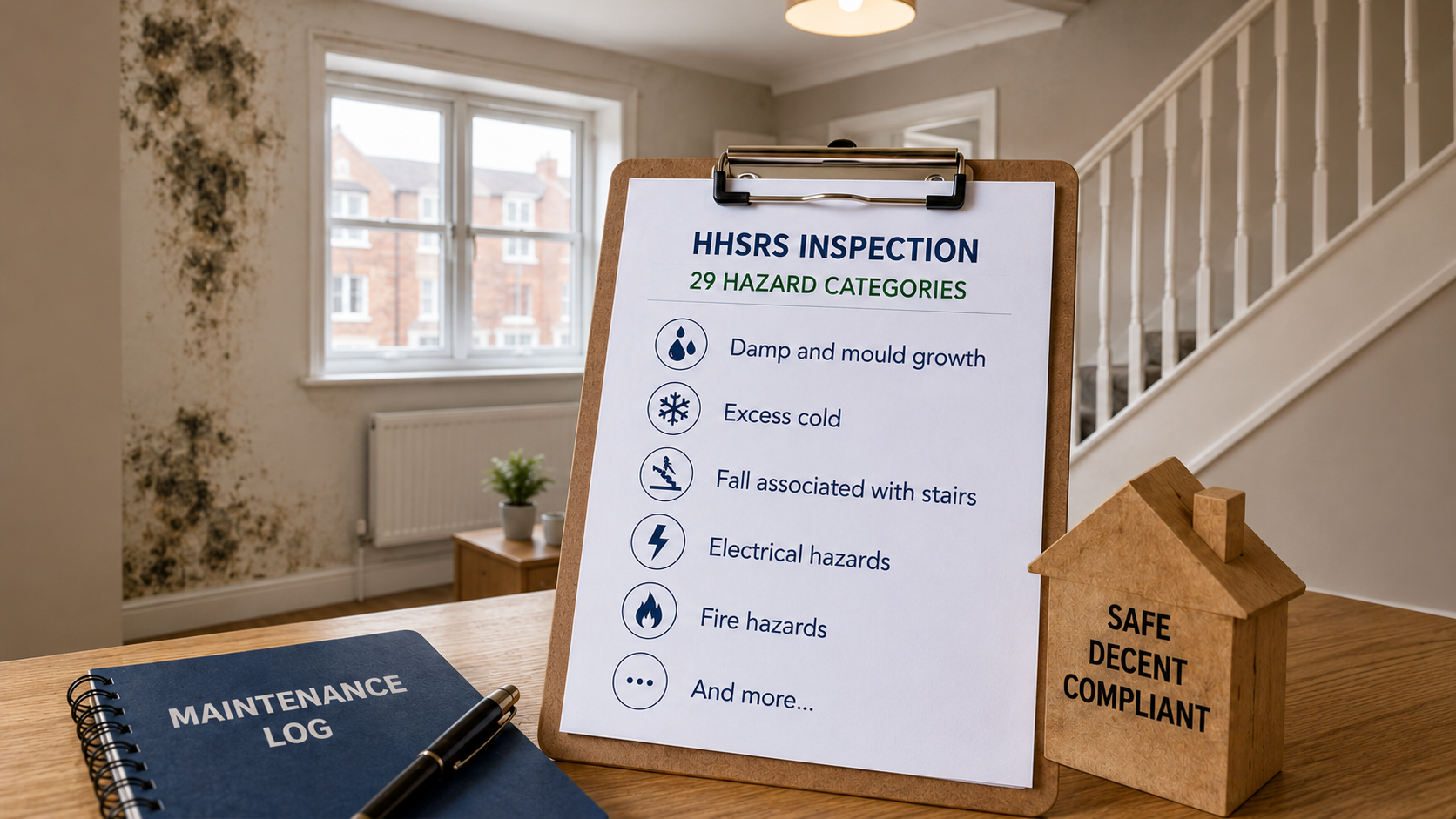
An inspection under the HHSRS is not a checklist tick-off — it’s a risk assessment scored against 29 hazard categories. The inspector walks the property, identifies any hazards, and scores each on the likelihood of an incident and the severity of the outcome.
Categories that most commonly produce a Category 1 hazard in older PRS stock:
- Damp and mould growth (especially post-Awaab’s Law)
- Excess cold (usually a heating or insulation issue)
- Fall associated with stairs
- Electrical hazards (often old consumer units without RCD protection)
- Fire (missing or non-compliant smoke alarms; inadequate escape routes in HMOs)
A single Category 1 hazard is enough to make the property non-decent.
Practical actions this quarter
- Do a self-audit. Walk each property with the HHSRS hazard list in hand. You don’t need to be an inspector — you just need to identify the obvious risks before someone else does.
- Prioritise damp and mould. Post-Awaab’s Law, this is the fastest route to a penalty notice. If a tenant has reported damp and you haven’t responded in writing within a reasonable time, you are already exposed.
- Document your response times. Keep a simple maintenance log with dates of reports, dates of contractor visits, and dates of completion. In enforcement, the paper trail is most of the defence.
- Budget for EPC C. Even though EPC C minimum is still in consultation at the time of writing, the direction of travel is clear. Energy-inefficient properties are increasingly likely to fail the thermal-comfort criterion of the DHS before the EPC regulations even catch up.
Sources
- Decent Homes Standard — gov.uk
- Housing Health and Safety Rating System — operating guidance
- Awaab’s Law — Social Housing (Regulation) Act 2023, extended provisions
This is general information, not legal advice. If a tenant has raised a disrepair or damp complaint that you think could lead to enforcement, get advice before responding.
Get briefings like this, monthly.
Landlord Brief is a short, plain-English digest of what's changing in UK rental law — with sources. One email on the 1st. Free.
Unsubscribe in one click from any email.